
Bitcoin may be bruised, but it’s not broken — at least not according to one of Wall Street’s most prominent asset managers.
In a bold appearance on CNBC’s Power Lunch, Jan van Eck, CEO of the $181.4 billion investment firm VanEck, declared that Bitcoin is likely carving out a market bottom.
His reasoning? The cryptocurrency’s hard-coded DNA.
⏳ The Four-Year Cycle Strikes Again?

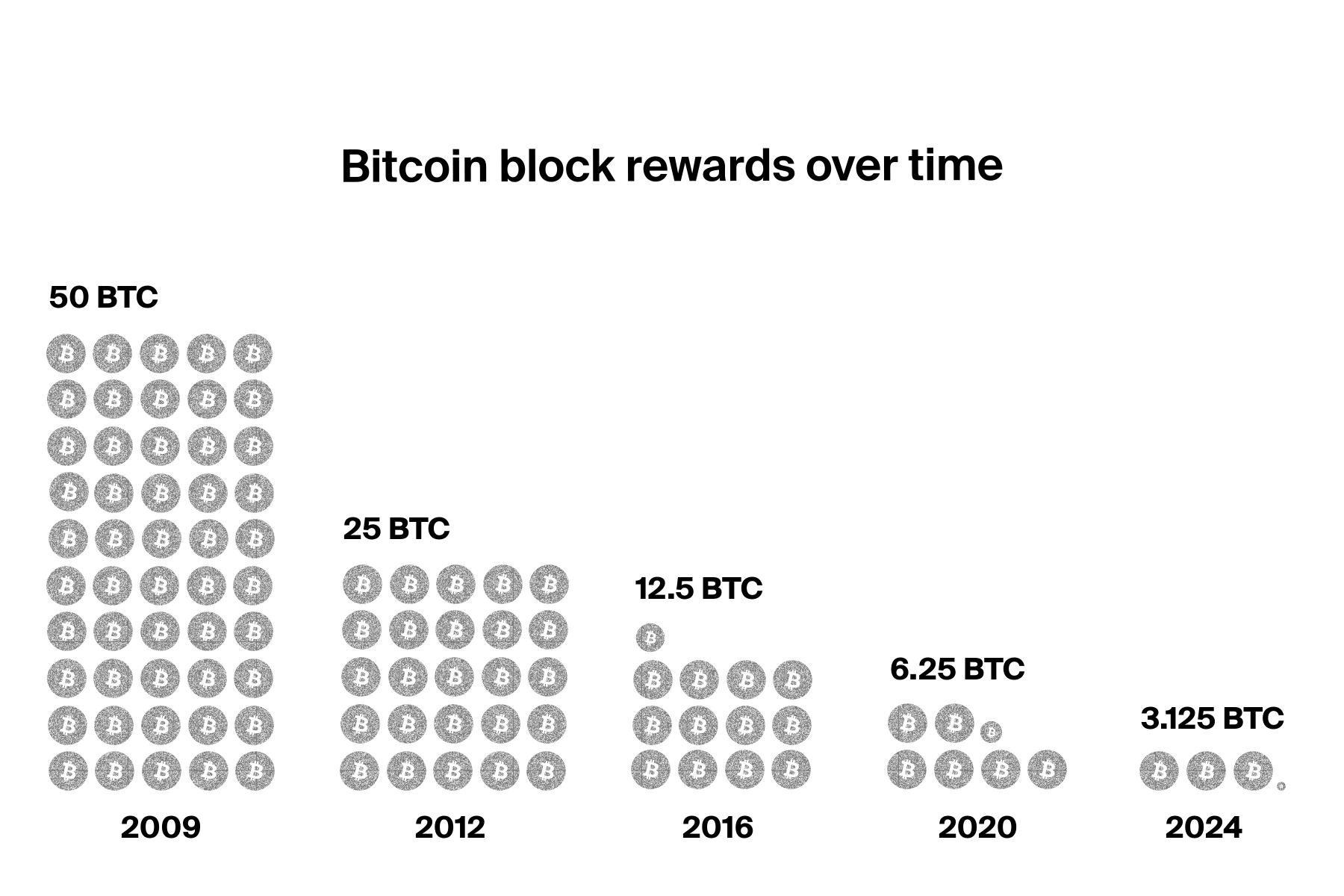
Van Eck anchored his argument in two immutable pillars of Bitcoin’s design:
Its fixed 21 million supply cap
Its four-year halving cycle
“Our view coming into 2026 is that Bitcoin is governed by the two things you know about Bitcoin — limited supply at 21 million, and the halving cycle,” he said. “Bitcoin goes up three years in a row, goes down pretty massively in that fourth year. 2026 is that fourth year. So that’s why we are in a Bitcoin bear market…. Now I think we are making a bottom.”
Historically, Bitcoin has followed a rhythm:
Post-halving supply shock
Explosive bull market
Euphoric peak
Painful correction
The most recent peak near $126,000, followed by a slide into the $60,000–$70,000 range, fits neatly into that narrative.
Research firm Kaiko supports this view, noting that the correction aligns with previous bear-market drawdowns and falls squarely within the typical 12–18 month window after a halving event when cycle peaks historically occur.
But there’s a catch.
📉 Bottoms Take Time — And Pain
Even if the cycle theory holds, history suggests bottoms rarely form overnight.
Bear markets have typically required six to twelve months to establish sustainable floors, often marked by multiple failed rallies before a decisive reversal.
On-chain analytics platform CryptoQuant reinforced this caution, reminding investors that bottoms are a process, not a single price level.
In a recent cycle comparison, CryptoQuant projected potential bottom windows based on historical traces:
2012 cycle mirror → June 4, 2026
2016 cycle mirror → September 24, 2026
2020 cycle mirror → October 30, 2026
Their broader estimate places a likely bottom between June and December 2026, with the highest probability between September and November.
In other words: even if Van Eck is right, patience may be required.
💼 Institutional Voices Echo the Bottom Thesis

The bottom narrative isn’t isolated.
Matt Hougan, CIO of Bitwise Asset Management, also cited the four-year cycle as one of three major factors driving recent investor de-risking. He too suggested Bitcoin may be forming a base.
Yet not everyone agrees the old playbook still applies.
A growing segment of analysts argues that Bitcoin has matured beyond mining-driven supply shocks. Instead, they say price action is increasingly influenced by:
Global liquidity conditions
Institutional capital flows
Macro policy shifts
Geopolitical risk
In this view, halving events matter less than central bank balance sheets.
📊 Where Bitcoin Stands Now
According to data from BeInCrypto Markets, Bitcoin recently traded at $68,217, posting a modest 3.4% daily gain amid rising geopolitical tensions.
The bounce has sparked cautious optimism — but not conviction.
If history rhymes, Bitcoin may be in the early innings of a drawn-out bottoming phase. If the cycle theory has weakened, macro forces could dictate a different trajectory altogether.
⚖️ Cycle or New Era?
The debate now cuts to the core of Bitcoin’s evolution.
Is it still governed by its programmed scarcity and predictable halving rhythm?
Or has it entered a new phase where global capital flows overpower mining mechanics?
Van Eck is betting the cycle lives on — and that the worst of the drawdown is behind us.
But as seasoned investors know, bottoms aren’t declared.
They’re discovered — slowly, painfully, and only in hindsight.